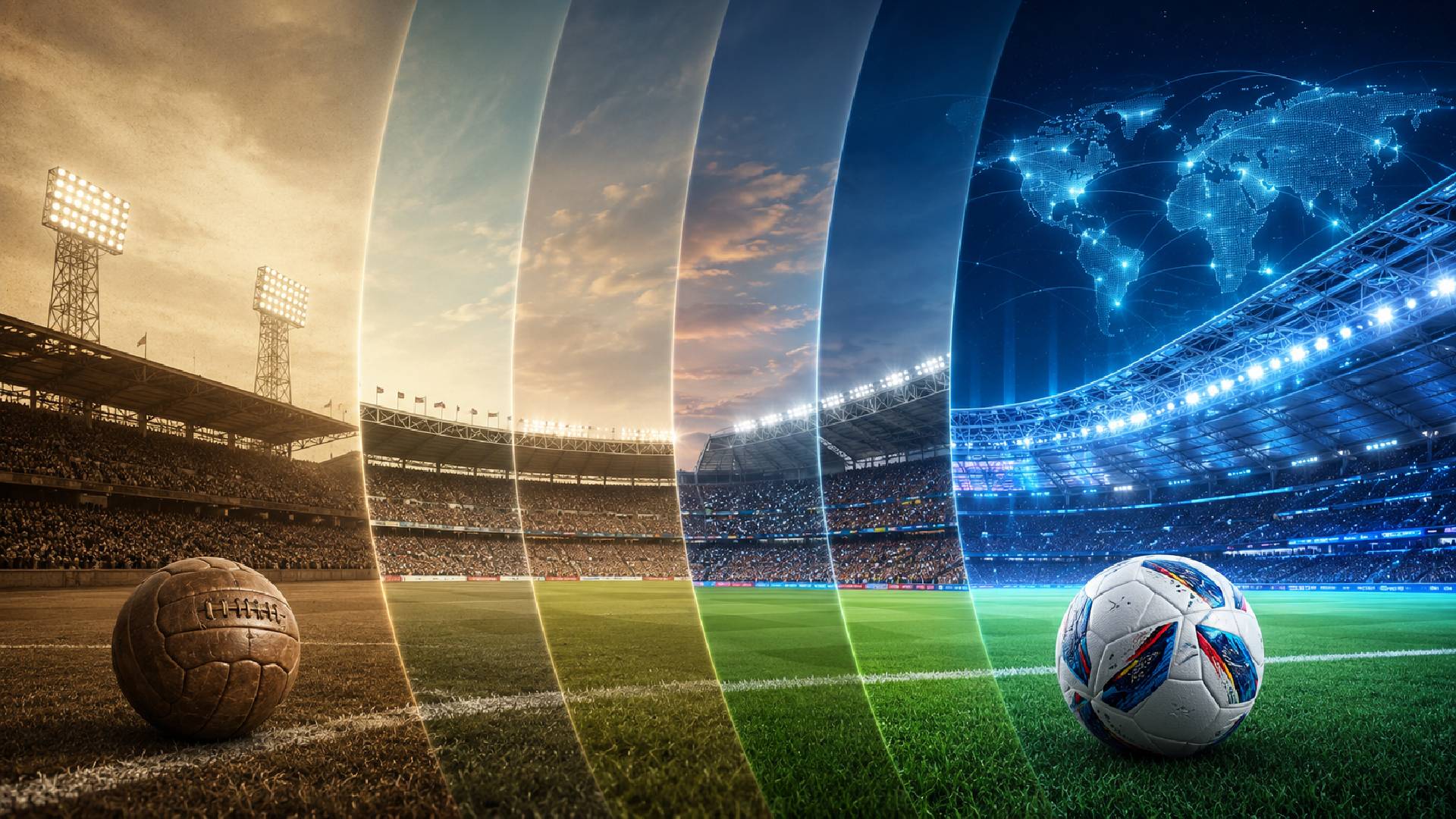
Football in 1974 and football in 2026 are two different universes. Over these years, the World Cup has evolved from an exclusive tournament for a select few to a giant show involving 48 teams, with stakes measured in billions of dollars. The change in format is not just an arithmetic increase in the number of participants. It's a total transformation of football philosophy, logistics, television technology, financial models, and even the physiology of athletes.
Let's break down this journey to understand why the "old" football is gone forever and what we have gained in return.
From 16 to 48 teams
The main thing that stands out when looking at history is FIFA's insatiable appetite. In 1974, 16 teams came to the tournament in West Germany. This format (4 groups of 4 teams, then quarter-finals, semi-finals, and final) was considered the gold standard: it was compact, dynamic, and ruthless. To win the title, you had to play just 6 matches. Every mistake in the group stage could be fatal, and sensations happened at every turn.
The key shift occurred in 1982 in Spain when the number of participants was expanded to 24 for the first time. This was an important ideological step: FIFA decided to pave the way for teams from Africa, Asia, and North America, which were previously almost completely cut off from big football. However, the resulting format was so inconvenient that it is often called a "monster". Six groups of four teams did not lead to the usual round of 16. Instead, a second group stage was organized — the remaining 12 teams were divided into 4 groups of three teams, the winners of which advanced to the semi-finals. As a result, the finalists played 7 matches in the tournament, and spectators were confused by the schedule. Moreover, this system spawned disgraceful fixed matches, where teams played for a mutually beneficial result, knowing that a draw would advance both teams. The 1982 tournament became an important but extremely painful lesson for FIFA.
The golden era began in 1998 in France when the ideal balance was found — 32 teams. Four teams in a group, the two best advance to the playoffs, starting from the round of 16. A total of 64 matches over exactly one month. The mathematics of this format is impeccable: intrigue persists until the last minutes of the third round, because even a team with two losses can theoretically take second place under certain circumstances. No unnecessary pauses and "dead" matches that decide nothing. This format lasted longer than any other — from 1998 to 2022 — and became the gold standard for an entire generation of fans around the world.
However, in 2026, we will witness another tectonic shift: 48 teams. This is almost a quarter of all FIFA members. The format had to be radically changed again because 48 teams cannot logically fit into the previous bracket. The new plan looks like this: 12 groups of 4 teams. All group winners and the 8 best second-placed teams advance to the playoffs. Thus, 32 teams reach the round of 16, and the tournament becomes like a long knockout race. The team that eventually wins the championship title will have to play 8 matches (group plus five playoff rounds) instead of the previous seven. Critics fear that the level of the "average" team will sharply decrease, and we will witness blowouts with scores of 10:0, which no one needs. Moreover, the physical fatigue of football players will reach absurd levels. But FIFA doesn't seem to care: more matches mean more tickets and television rights.
The evolution of the qualification system and "jokers"
Half a century ago, qualifying for the World Cup was an elite privilege. Europe and South America received the lion's share of places. In 1974, Europe had 9.5 spots (the half meant a playoff match with another confederation), South America had 3.5. The rest of the world collected crumbs: Africa was content with one spot, Asia and Oceania shared one. This reflected the power balance of the time: football was considered a European-South American sport, and everyone else were just extras.
Today, the geographical format has expanded beyond recognition. In 2026, Africa will have 9 direct spots, Asia 8, North and Central America 6 (plus three host countries automatically qualify). Oceania finally received a guaranteed place. At the same time, inter-confederation playoffs remained, but they turned into a nerve-wracking lottery even for the giants. Now, to qualify for the World Cup, it's not enough to have historical weight or a star lineup — you need to be in the right form for two specific playoff matches. A striking example in recent years: a European giant with multi-million budgets failed to beat a modest team from Eastern Europe in the playoffs and was left out of the tournament. This is the price for the "democratization" of qualification, where momentary form is more important than a big name.
Timeframes: from one month to two
In the 1970s and 1980s, the World Cup fit into 23–25 days. Matches were played tightly: two or three matches a day in the group stage, breaks between playoffs were minimal. Players took the field tired but emotionally "fresh," and there were fewer injuries because the modern frenetic pace with high pressing didn't exist yet.
Now the situation is radically different. The recent tournament in Qatar, held for the first time in autumn instead of summer, clearly showed that a modern footballer is physically incapable of playing at the limit every three days. Additional rest days were required between the quarter-finals and semi-finals. And the 2026 World Cup, which will be held in the USA, Canada, and Mexico, will stretch over 40 days. The tournament will start in mid-June, and the final will take place on July 19. This is no longer a sports "weekend," but an entire summer show, comparable in duration to the Olympic Games. Due to the expansion to 48 teams, matches will start at an unusually early time — 11 am local time, especially in hot cities like Houston or Dallas. This, in turn, forces a reconsideration of the game's physiology. Mandatory water breaks (so-called "cooling time-outs") have appeared, where the referee stops the game for a few minutes in the middle of a half so that players can drink and recover. Fifty years ago, such things weren't even considered — they just endured the heat.
Technology: from live refereeing to total control
Perhaps the most radical break with the past is the massive intervention of technology in the "flow" of the game. In 1974, the referee was king and god on the field. His word was not questioned, and his mistake became part of folklore — such moments are remembered for decades. FIFA resisted automation for a long time, but the last ten years have been an era of technological revolution.
The goal-line technology appeared in the mid-2010s. The debate over whether the ball crossed the goal line died forever. The referee receives an instant signal on an electronic watch, and there is no need to peer into a replay and guess. For tournaments in the 1970s, this would have been science fiction.
Video assistant referee (VAR) is a real revolution that began at the 2018 World Cup. Now any controversial moment (penalty, offside, red card, goal scored with a rule violation) leads to a pause of one to three minutes while the referee in the studio watches replays. It broke the intrigue of spontaneous goal celebration. Before, when the ball hit the net, you could immediately shout "GOAL!" Now you freeze and anxiously look at the referee, who puts a finger to his ear. The plus of the system is obvious: it makes football fairer. The minus is that it kills live, immediate emotions.
The latest technological leap is semi-automated offside, applied at the tournament in Qatar. Artificial intelligence with the help of special cameras and sensors on boots determines the "offside" position in fractions of a second. On screens, viewers are shown three-dimensional graphics clearly showing how many millimeters the attacker was ahead of the defender. In 1974, the referee ran along the sideline with a flag in hand and made the decision by eye. Now offsides are fixed with millimeter accuracy, and this causes a wave of criticism from romantics: football, they say, is turning into mathematics, where each armpit or heel can cancel a beautiful goal.
Financial format: from free TV to paid giants
In 1974, television broadcasts were scarce. In many countries, not all matches were shown, only the final and, by happy coincidence, the semi-finals. FIFA made money mainly from tickets and souvenir merchandise. Commercial breaks and brand names on jerseys were considered bad form — the kits were clean, without advertising.
Today, the World Cup is a money-making machine of incredible scale. The total prize pool of the last tournament exceeded $400 million, and the winner received about $40 million just for reaching the final. How has the commercial format changed?
First, stadiums now have corporate names. What was unthinkable fifty years ago is now the norm: major energy companies pay tens of millions to name the arena after themselves during the tournament.
Second, title sponsors from the world of beverages, sports equipment, and finance spend billions on association with the World Cup. Their logos appear everywhere: from advertising boards around the field to special zones inside stadiums.
Third, scheduling matches for television — a key change that ordinary viewers don't even think about. Previously, the final was played at three o'clock in the afternoon local time. Now the start time of the final (usually 18:00 local) is a complex compromise between Asian prime time (morning there) and American evening. For the sake of TV audiences in Asia, matches can start at 1:00 pm local time, even when it's scorching hot at the stadium. That's why air conditioning systems were needed at arenas in Qatar. Moreover, a whole format of "hubs" for teams has appeared — huge bases with hotels, training fields, medical centers that brands rent for millions, turning into closed advertising platforms. Fifty years ago, teams stayed in regular hotels and trained on city fields.
Logistics and geography: from one country to three
Half a century ago, the World Cup was held by one country. Exceptions were extremely rare. The entire tournament geography fit on a relatively small territory. In 1974, for example, all of West Germany was covered by a network of autobahns, so teams easily moved by bus between cities. The climate was uniform, and the time zones were the same.
Starting from 2026, an unprecedented format will come into force: three host countries simultaneously — the USA, Canada, and Mexico. This creates unique logistical problems that no one thought of half a century ago.
Flights become the main headache. A team from one group may play in Miami, and in the playoffs, it may be sent to Vancouver — this is a five-hour flight and a three-hour time difference. In 1974, the maximum transfer was an hour or two by bus. Now coaching staffs have to hire chronobiology specialists to properly adjust players' sleep and eating schedules.
Climatic zones are another challenge. Teams will jump from cool and rainy Seattle to the scorching heat and high altitude of Mexico City, where the stadium is located more than two thousand meters above sea level. Acclimatization to altitude and humidity becomes a separate science. Fifty years ago, teams simply arrived three days before the match and played. Now they arrive one or two weeks in advance and undergo special preparation cycles.
Security and visa regime are a third surprise. In 1974, footballers flew in, showed their passports, and entered the country without fuss. Today, organizing the entry of 48 delegations from countries that are not always friendly with the USA and Canada requires gigantic bureaucratic work. FIFA has to negotiate with the governments of three countries for expedited visa processing for thousands of players, coaches, and officials.
Cultural code: from battles of character to the science of victories
Football in 1974 was a confrontation between the "total football" of the Dutch and the German pragmatism. The preparation format was simple to the point of naivety: two friendly matches, one coach's instruction in the locker room, a break for a smoke at halftime. Players were prepared with "grandfather's" physical training methods: runs, weight work, many tactical schemes on the board.
Today, the format of the World Cup includes entire scientific clusters. Top teams have dozens of specialists working with them, about whom no one heard fifty years ago: biomechanists, nutritionists, psychologists, data analysts, recovery specialists.
Big Data analysis systems — each team hires up to twenty analysts who, in real-time, edit video moments of the opponent, track each player's movements on the field using GPS sensors. The coach watches not only the field during the match but also a tablet with heat maps and fatigue graphs.
Microchips in the ball — the latest technology trend. The ball transmits data about each touch, flight speed, and rotation 500 times per second. In decisive matches, penalties were awarded after consultation with sensors in the boots and ball, which recorded millimeter touches.
The rule of five substitutions instead of three (it became permanent after the pandemic) completely changed tactics. Now a coach can release two or three fresh "runners" for the last half hour of the game without fearing to run out of substitutions in case of injuries. The match breaks into several speed segments, and the team that better manages substitutions gains a colossal advantage. In 1974, there were only two substitutions, and they were used only in case of real injury — replacing a tired but healthy player was considered almost disrespectful to his physical condition.
Psychological pressure and fan interaction format
The format of interaction with fans has mutated beyond recognition. In 1974, fans came in their cars, often old and rusty, slept in tents near stadiums or in cheap hostels. Tickets were bought at the stadium box office on the day of the match for cash. The atmosphere was local, almost village-like, but at the same time quite aggressive — clashes between fan groups were commonplace.
The modern fan format is regulated down to the smallest detail.
Digital fan passport — a system that appeared after serious stadium riots but reached its peak at the recent championships. Without a special identifier linked to your ticket and passport, you won't get not only into the stadium but often not even onto free public transport on match days. This ensures safety but kills the spirit of spontaneity.
Official fan zones with giant screens in city centers — a format that did not exist in 1974. Now it's a separate business: beer from a title sponsor, entertainment program, contests, concerts. Tens of thousands of fans who couldn't buy a ticket to the stadium gather together to watch the match outdoors.
Tourist packages — the most elite and expensive format. FIFA sells official tours that include a hotel of at least four-star category, tickets to all of the team's matches, transfers by air-conditioned buses, and even excursions. The cost of such a package can reach tens of thousands of dollars. This has excluded ordinary "wild" fans who travel on their own money with minimal comfort. The World Cup has ceased to be a people's feast and has turned into an attraction for the middle and upper class.
Fate of "small" teams: sensations versus formal participation
The expansion to 48 teams created a paradox that torments football lovers. On one hand, it is the expansion that has given us legendary historical moments. An African team defeating the reigning world champion in the opening match, or a Central American team advancing from the group of death where future finalists played — these stories became possible precisely because FIFA gave underdogs a chance.
But on the other hand, the number of passable, boring, one-sided matches grows with each expansion. In 1974, there were virtually no clear underdogs in the group. Even a modest team by European standards could give any giant a fight. Then football was more even because only the strongest of the strongest were selected for the tournament.
In 2026, groups will feature teams that previously never even came close to the World Cup. Matches like England vs. Tahiti or Germany vs. Burkina Faso with double-digit scores are no longer sports in the usual sense. This is a statistical anomaly that brings joy to neither the winners (who gain no useful experience), nor the losers (who feel ashamed), nor the spectators (who turn off the TV after the third goal). Moreover, the format with 12 groups and eight best second places kills intrigue already in the second round: if one team has guaranteed a playoff spot, and another has lost all chances, their head-to-head match becomes a formality.
Match for third place: rudiment or tradition?
A funny detail that is often forgotten but is very telling. In 1974, the bronze match was considered a boring formality. The stands were barely sixty percent full, players took the field without the right mindset, and the only thing motivating them was personal pride.
Fifty years later, this match still exists, although the vast majority of coaches hate it. An extra match before the final means a risk of injury for key players. The team that lost in the semi-finals is emotionally drained, and forcing them to play another "official" match seems like mockery. Nevertheless, FIFA does not cancel it for two reasons. The first is tradition. The second is more cynical: an additional day of broadcasts, additional commercial breaks, additional money. Notably, no other major football tournament in the world (for example, the European Championship or Copa America) holds a third-place match anymore. Only the World Cup retains this archaic element, and its fate in the new 2026 format is still unclear.
Conclusion: what have we lost and gained over half a century?
Summarizing fifty years of format changes, the main conflict can be identified: FIFA is consistently turning sport into a sports industry. And this process has both clear advantages and equally clear disadvantages.
What have we lost?
-
Improvisation and live error. Now every controversial action is captured by dozens of cameras, and the magic of "divine refereeing" is gone. Football has become too sterile.
-
Compactness and clarity. The system with 48 teams, 12 groups, and eight "lucky" second places is so confusing that even avid fans won't always quickly understand who needs to root for whom in a parallel match.
-
The romance of long journeys, when a fan plotted his route, slept at train stations, and bought tickets "from hand". Modern digital control and tourist packages have killed this layer of football culture.
-
The significance of each individual match. When not just the two best teams from the group but two plus eight second places from the entire tournament advance, losing to an underdog stops being a catastrophe. This reduces the intensity of passions.
What have we gained?
-
Global reach. The World Cup is watched in every village of any country in the world. Small nations have gained the chance to be part of a great celebration.
-
Fairness. VAR, the goal-line technology, and semi-automated offside minimize referee errors. No one will win the title again because of the obvious "hand of God".
-
Safety. Digital passes, metal detectors at every entrance, control over fans in the city — there are no longer deadly fights at stadiums, and this is progress.
-
Football as a Hollywood-scale show. The opening and closing ceremonies have turned into multi-hour theatrical performances with the world's best musicians.
The 2026 World Cup in the USA, Canada, and Mexico will be a stress test for the new format. Will 48 teams, 104 matches, and three weeks of additional rest preserve what we love about the "Mundial" — the nerves at stake and the feeling that each game is the last? Or will we face a sluggish summer festival with the obligatory checkbox "participated" for two dozen teams that are just happy to be invited?
One thing can be said for sure: those who witnessed the 1974 World Cup in West Germany or the great 1998 tournament in France will never fully accept the new format. And the generation that grew up on replays and five substitutions will find it ideal. And in this gap lies the main result of half a century of evolution. Football has ceased to be just a game. It has become a global operating system. And like any system, it requires constant rebooting, updates, and compromises between the spirit and the letter of the law.